JACOB
racist Connotations in Vocabulary
listen to the story
Jacob’s escape was announced in the Quebec Gazette on August 20, 1778. Enslaved by innkeeper Miles Prentice, he is described as well made and very active, 5 feet 5 inches, and speaking little or no French. It also said that he was "mulatto." This term, from the Portuguese mulato (mule), applied to children who had black and white parents at a time when these human beings were treated as livestock.
mixed race, a proof of sexual abuse
The presence of people of mixed race in slavery—whether here or elsewhere in the Atlantic world—serves as a very concrete illustration of the sexual abuse suffered by enslaved women. Due to the power dynamics binding the enslaved person to the enslaver, consent was simply not possible within the context of slavery. Children born as a result of this violence always took on their mother’s status: if she was enslaved, so was the child. Of the 13 people featured in the exhibition Fugitives!, at least five are identified as people of mixed race: Bell, Jacob, André, Lydia, and Jane.
We know very little about Jacob, but we do know that Miles Prentice enslaved at least five people. He had purchased a man and a woman from Governor James Murray in the 1760s. In 1769, he attempted to sell the woman, her 9-month-old mixed-race son, and a 23-year-old man at auction. The woman was described as a good servant who handled milk well and churned butter to perfection. The man was described as a good servant, as having a firm understanding of his work as a valet and looks well in his livery (the servant’s uniform). In a subsequent advertisement, Prentice touted his skills as a cook. In 1773, an 11-year-old enslaved boy was listed as living in his household. In 1786, George Williams, age 63, was baptized at the General Hospital.
Illustrated by PAUL BORDELEAU
Was Jacob the 11-year-old child listed as living with Miles Prentice in 1773? When he escaped five years later, his estimated age was 18, and the young man in the census would have been 16 at the time. Given the fact that the age of an enslaved person was always approximate, it’s possible that it was the same person.
read the wanted notice
Jacob "a wanted Mulatto"
Slavery left such a deep imprint on societies with a colonial past that their vocabulary was steeped in it. Shaped by scientific discoveries about animal species, racist vocabulary makes extensive use of animal imagery, in particular cattle, and the notion of crossbreeding between species.
Dehumanize and reduce to the status of animals
The purpose of the term “nigger”, for example, is to dehumanize the people designated as such, to reduce them to the status of beasts, and to see them as heads of cattle or inventoried merchandise. The expressions mulatto, bastard, half-breed and simian racial slurs also attest to this strategy.
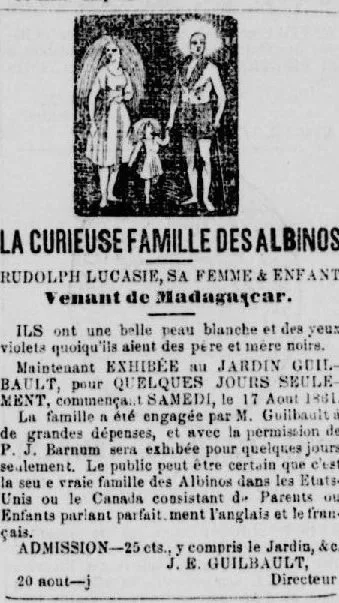
Caption: La Miverve, 20 août 1861.
Over time, and as a result of genetic mixing largely due to the rape of enslaved persons by slaveholders, color-based classifications emerged in the Atlantic world, such as “quatroon” (one-quarter Black) and “octoroon” (one-eighth Black). Children born of these violences were classified according to the lightness of their skin color. The lighter their skin, the more privileges they could obtain. This phenomenon can be observed in all societies with a colonial past. This is what is now known as the dynamics of colorism.
Caption: La Minerve, 6 septembre 1862
The rights to equality and human dignity
With its essentialist content, racist language denies racialized people of their membership in the human community, even though this affiliation is proclaimed in the Universal Declaration of Human Rights. The right to equality is inseparable from the right to respect for dignity. Adverse differential treatment of an individual or a group based on personal characteristics violates both these rights simultaneously. For example, denying someone access to a business, restaurant or transportation because of his or her skin colour is a discriminatory practice that violates the right to equality. Such practices are prohibited in Canada under the Canadian and Québec Charters. Such treatment undermines the dignity of the person and has harmful consequences. This is what entitles the person who suffers discrimination to demand reparation. The Québec Charter also prohibits harassment on discriminatory grounds, including skin colour.

learn more about the rights to equality

Test your knowledge
Where does the term mulatto comes from?
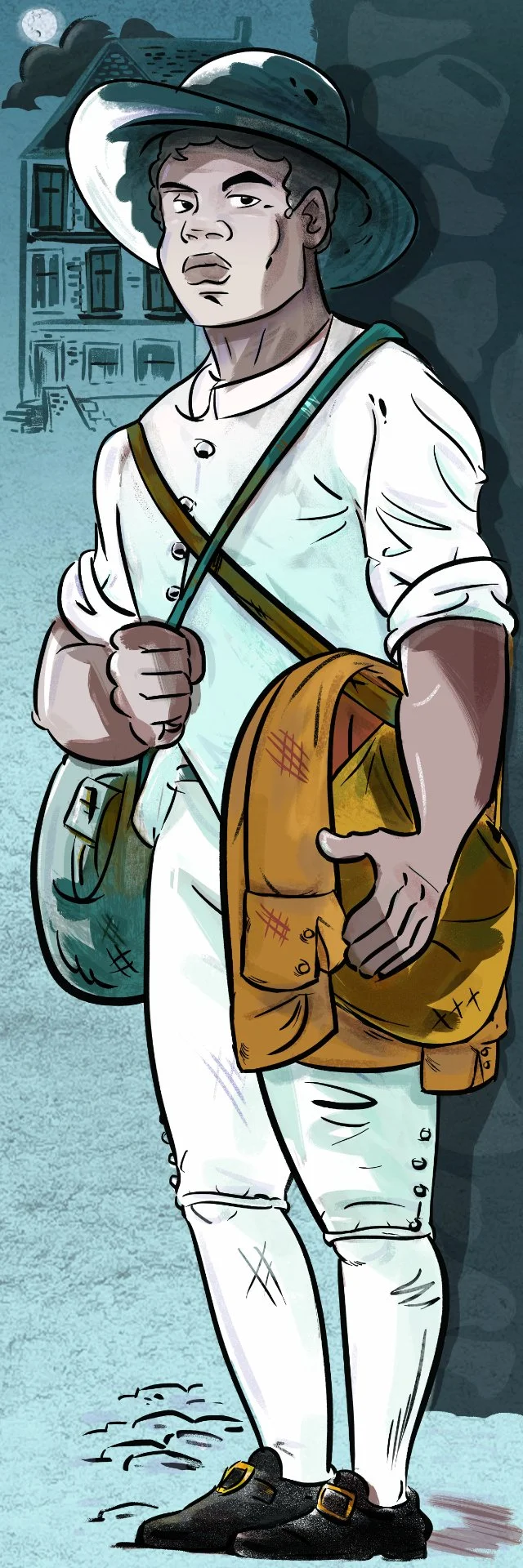
Illustration by Paul bordeleau