


context
Many people are still surprised that slavery did indeed exist in Quebec and Canada. Contrary to what many historians have claimed over the years, the St. Lawrence Valley was not immune to this practice, which accompanied European colonization throughout the Americas.
Historian Marcel Trudel documented 4,185 enslaved persons in Quebec’s history, from the arrival of Olivier Le Jeune in Quebec City in 1629 until the official abolition of slavery in the British Empire on August 1, 1834. However, this number is not accurate. This is partly because Trudel believed that every person of African descent in the past was enslaved, and partly because the practice had already disappeared in Quebec some thirty years before its official abolition in the British Empire. Another reason for this inaccuracy stems from the fact that not all enslaved persons left a trail in the archives. Thus, the figure of 4,185 serves primarily to illustrate this presence within the context of an Atlantic world that absorbed between 12 and 13 million African souls over nearly 400 years.

Caption : illustration by ValMo, Le Grain de Sable, Olivier Le Jeune, premier esclave au Canada. Septentrion. 2019
Domestic slavery
Slavery in Quebec was mainly of a domestic nature, in contrast to the economic plantation slavery found, for example, in the southern United States, Brazil, or the West Indies. The reason for this difference was not some kind of moral superiority, but rather the climate. The harsh winters made it impossible to grow sugar, cotton, coffee, or cocoa; thus, the economy of New France revolved primarily around the fur trade and fishing and was not based on large-scale agricultural operations. As early as the 1680s, Governor General Brisay de Denonville asked King Louis XIV of France to grant the colony the right to own enslaved persons, which he did. However, the political circumstances of the time, the distance, and the climate meant that no slave ships ever unloaded their cargo directly in the St. Lawrence Valley. Residents were nonetheless able to acquire enslaved Black persons by purchasing them locally or ordering them from the Thirteen Colonies, Louisiana, and the West Indies. Many of them arrived in the second half of the 18th century with the Loyalists fleeing the nascent republic that would become the United States.
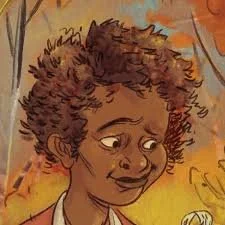
Caption: Illustration by ValMo, Le Grain de Sable. Olivier Le Jeune, premier esclave au Canada. Septentrion. 2019
Enslaved Black and Indigenous
Of the 4,185 slaves recorded, one-third were Black—1,443—and two-thirds were Indigenous—2,683 people. These First Nations people were sometimes called “panis.” A large number of them came from the Great Lakes region and what is now the American Midwest. Regardless of an enslaved Indigenous person specific nation, they were often referred to as “panis.” This word was a corruption of the term “Pawnee,” a nation from which slaves had been captured or purchased at some point. Over time, this term became a generic term for enslaved Indigenous peoples.
advertised in newspapers
There were no markets specifically for the sale of enslaved persons in Quebec, but many of them were nonetheless sold at markets or auctions. Beginning under the British regime and the advent of the print media—marked by the founding of the Gazette de Québec by William Brown in 1764—slaves for sale were now advertised in newspapers. The same was true for the enslaved who ran away.
Caption: La Gazette de Québec, may 22nd 1794.
In the absence of portraits of enslaved persons from that era, the wanted notices published between 1767 and 1798 are the most detailed records we have regarding the appearance of these men and women dehumanized by slavery. Since the purpose of these notices was to track down these fugitives, the enslavers described them in great detail—whether regarding their clothing, physical appearance, or specific distinguishing features such as hair, language spoken, mixed-race heritage, or pregnancy. These notices also reveal the various strategies these individuals employed to gain their freedom. A warning often followed these wanted notices to discourage people or ship captains from aiding them.
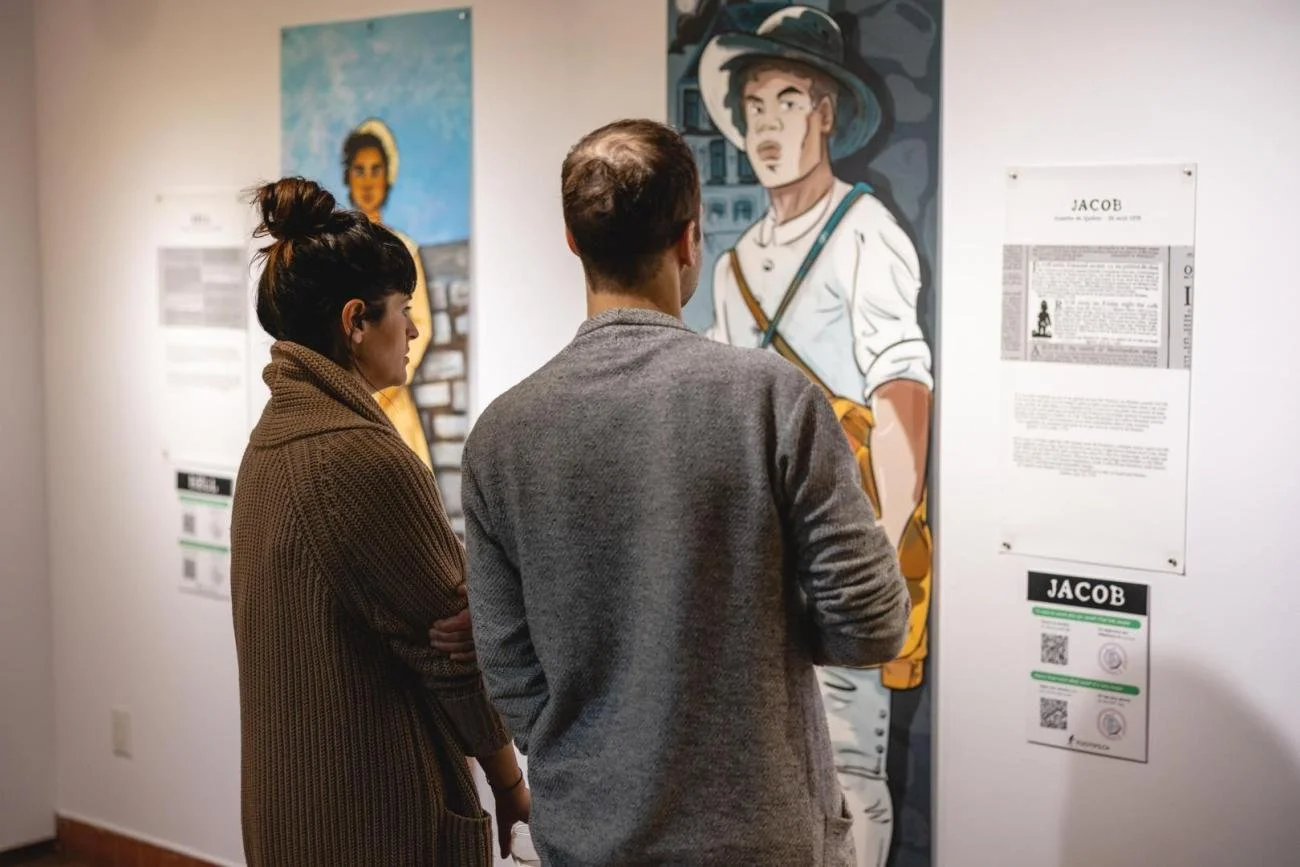
Caption: the Fugitifs! exhibition at the Musée National des Beaux-Arts du Québec.
An Exhibition to Rehumanize People who were rendered invisible
This exhibition allows us to visualize enslaved persons living in Quebec during the second half of the 18th century based on detailed descriptions of them. Its goal is to restore a human dimension to people who were treated as personal property—sold, bought, given away, bequeathed, rented, or exchanged.
A Long Way to Go in Representing enslaved Indigenous persons
Given the large number of Indigenous enslaved persons in Quebec (twice as many as people of African descent), their near-total absence from this exhibition may come as a surprise. However, the enslavement of First Nations people occurred primarily during the New France era, and since this project is based on newspaper advertisements published under British rule, they are less prominently featured.
Figures That Are Not Very Representative
In total, since the advent of the print media in Quebec, 43 sales announcements have been published concerning people of African descent, and 51 regarding runaways. However, not all sales were advertised in the newspapers, nor were all desertions. The actual numbers, in both cases, are necessarily higher, especially since the era of New France is not included. The information presented in this exhibition is drawn, among other sources, from Marcel Trudel’s Dictionnaire des esclaves et de leurs propriétaires au Canada français and Frank Mackey’s Done with Slavery (L’esclavage et les Noirs à Montréal in french).

Running away as an Act of Resistance
Unlike the rest of the Americas, where the enslaved population was much larger, resistance to slavery in Quebec could only take the form of escape. There were not enough people to foment armed rebellions, as had been the case elsewhere on the continent. Thus, the escape of enslaved persons from Quebec and Canada stands as a powerful symbol of agency and refusal to accept their condition of servitude; they resisted to the best of their ability given their limited numbers. The escape of these enslaved persons must be viewed as an act of resistance. There is very little information about these people, who, as chattel, were not considered at all on the social ladder. Furthermore, since the goal of escape was to avoid recapture, it is even more difficult, two hundred years later, to trace these individuals. Several hypotheses must be considered in order to better understand them. Even though slavery in the St. Lawrence valley was mostly domestic, compared to the rest of the Atlantic world and its plantations, parallels with the rest of the continent have to be drawn, as Quebec, too, was part of this colonial world.
test your knowledge!
from slavery to human rights
-
Bought and sold, bequeathed, given away, rented, or traded without regard for their family or marital ties, people held in slavery were treated as property.
Since enslaved persons had no more rights than cattle or objects, their enslavers profited from their forced labor, their bodies (through sexual violence), and their reproduction (by appropriating their children, often as a result of rape by the enslavers) without any restrictions.
Uprooted from their communities, separated from their parents and children, despised, neglected, starved, threatened, abused, confined, and raped with no recourse, many enslaved persons attempted to escape.
Running away, an act of resistance against injustice, was then considered an act of disobedience and insubordination punishable by the enslavers.
-
Slavery is a situation of absolute denial of human rights that allows us to grasp their full significance.
Deprived of rights, anyone in slavery is condemned to carry out the will of their enslavers, even if it leads to their death.
It was to put an end to such abuses that human rights were proclaimed, guaranteeing every human being a set of inalienable rights and freedoms from birth to death.
In 1948, the Universal Declaration of Human Rights proclaimed that “All human beings are born free and equal in dignity and rights. They are endowed with reason and conscience and should act toward one another in a spirit of brotherhood.”
For its part, the International Covenant on Civil and Political Rights, which entered into force in 1966, prohibits slavery in all its forms and reaffirms the principles of fundamental rights and freedoms.
In Quebec, the Canadian Charter of Rights and Freedoms and the Quebec Charter of Human Rights and Freedoms are the legal instruments that protect these rights and freedoms.
Discover these rights and freedoms throughout your visit.