
bett
pregnancy in slavery
Listen to the story
Bett’s escape was published in the Quebec Gazette on March 6, 1787. She was approximately 18 years old and was enslaved by the merchants Johnston & Purss. Both of Scottish origin, the men specialized in the sale of furs, seal oil and wheat and were also distillers. Some 16 years earlier, they had held another person in slavery, Pompey, who ran away in 1771.
A $20 reward was offered for finding Bett.
Pregnancy in slavery
There are two things that are striking in this announcement. The first is that she was described as "big with child, and within a few days of her time." We have no idea of what drove her to escape in March 1797, but it must have been done in haste. As in many cases in slavery, it’s very likely that she didn’t want her child to be born under such circumstances. Bett was even suspected of killing her child after she lost her baby two months later.
There is a parallel to be made elsewhere in the Americas, with Solitude in Guadeloupe. She was pregnant when she joined Louis Delgrès’ rebellion against the restoration of slavery under Napoléon Bonaparte in 1802. Solitude was apprehended and jailed and was executed the day after she gave birth.
Bett’s suspected infanticide may also remind us of the case of another fugitive: Margaret Garner in Ohio in 1856. About to be caught by the authorities, she preferred to kill her two-year-old daughter rather than see the child returned to slavery. This story would inspire Toni Morrison’s novel Beloved in 1987.
Illustrated by MALICIOUZ

read the wanted notice
speaking many languages
Another thing that strikes us as unusual in the wanted notice for Bett is the reference to language. She could speak English, French and German. However, it wasn’t uncommon for enslaved persons to be multilingual given the variety of enslavers they would have served, in addition, of course, to their mother tongues if they were born in Africa or had African parents. This was also the case for other runaways: Joe and Jack, who spoke English as well as their mother tongues, Nemo and Cash spoke English and French, Ishmael spoke English, French and Dutch. And Andrew spoke English, French, Dutch and Erse.
The following July, Johnston & Purss published an announcement for the sale of a robust, healthy and active woman of approximately 18 years of age. She was described as having had smallpox, as knowing how to cook, wash and iron, as being very good with children, and she spoke English, French and German. Clearly, it was Bett they were trying to sell off.
Bett "Pregnant and within a few days of her time."
In slave systems, the bodies of enslaved people were at the entire disposal of their enslavers. In addition to domestic work, abuse and sexual violence towards enslaved women were widespread and made commonplace. Appropriation by the enslaver was absolute and the children born of sexual assault became their “property”. As a result, reproduction was also exploited. Even breastfeeding was likely to be exploited in the Atlantic World, where many enlsaved women became wet nurses for the enslaver’s "legitimate" children.
The control of women’s bodies
The control of women’s bodies, particularly those of racialized women, and of their reproduction, extended well beyond slavery, and were the stuff of racist public policy. Among other indignities, the forced sterilization of racialized and Indigenous women, as well as the mandatory placement of Indigenous children in orphanages and residential schools, existed until very recently in Canada.
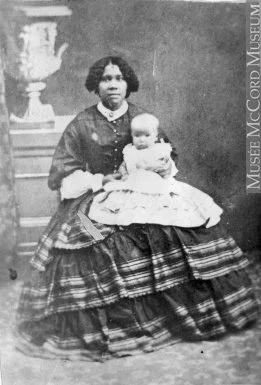
Caption: Nurse and baby, copied for Mrs. Farquharson in 1868. I-31290.0.1 © McCord Museum
Human trafficking and forced sterilization
Despite these legal safeguards, human trafficking still exists, targeting racialized women and girls more specifically, and forced sterilization still occurs in Indigenous and racialized populations. In Canada, the last cases of forced sterilization of Indigenous women were in 2018.
The notion of consent
At the top of the list of fundamental rights is a person’s right to life, security, liberty and integrity. These inalienable human rights guarantee each person the right to make decisions about their body, including their sexuality and reproduction, without outside pressure or fear of reprisals. Consent is not valid unless it is freely given. These protections are particularly important for women, given the issues of reproductive health and freedom of choice in matters of contraception, pregnancy, and support with birthing and breastfeeding.

podcast about trafficking in women in Canada (French only)

Test your knowledge
What happened to Bett's baby?

Illustration by MALICIOUZ